BUY UGANDA VANILLA BEANS SOYBEAN OIL
Uganda Oil Tax News
by MN
The Oil Tax Meeting
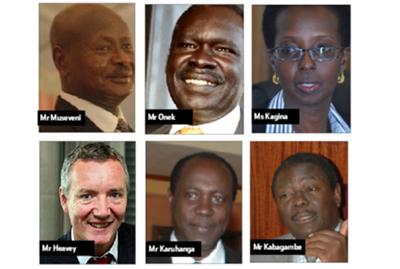
On Monday August 23, at around 9a.m., a delegation met President Museveni at the State Lodge in Jinja. The delegation included Energy Minister Eng. Hilary Onek, Permanent Secretary Fredrick Kabagambe-Kaliisa, Uganda Revenue Authority boss Allen Kagina, Finance Minister Syda Bbumba and her Permanent Secretary Chris Kasami as well as Aidan Heavey, the CEO of Tullow Oil and Elly Karuhanga, the president of Tullow Oil Uganda. Less than a month earlier, Tullow had paid Heritage $1.045 billion to buy its assets in Uganda.
It had also paid URA $121 million on behalf of Heritage and paid $283 million into an escrow account with Standard Chartered Bank London, pending arbitration between government and Heritage over the $405 million total tax claim.
Government rejected the deal and said it wanted the tax money paid in full.
The Heritage shareholders had received their cut and had swiftly pulled out of Uganda. Mr Heavey, who now found that he could not sell off a two-thirds stake to Total and China’s National Offshore Oil Corporation, had asked for the meeting to find a solution to the capital gains tax which wasn’t his but which he now owned. Without government approval, Tullow would have thrown away over a billion dollars down the drain. The government team met the President first, while the Tullow team, which also included Mr Brian Glover, their man on the ground in Uganda, waited outside.
The Tullow team was later let in.
Both meetings didn’t last long. The President asked Mr Heavey whether Tullow was going to pay the tax incurred by Heritage. Mr Harvey said no, but Tullow was more than ready to pay its own tax obligations once it sold on to TOTAL and CNOOC. Shortly after, President Museveni got up and left the room.
No tax, no discussion was the writing on the State Lodge walls.
Different strokes
How did Tullow Oil get to pay so much money without a guarantee or a fallback position? Sources familiar with the matter told this newspaper that Tullow was caught in the quicksand of influence peddling and blinded by a “rogue” letter from the energy ministry.
The question of whether Heritage’s sale of assets attracted capital gains tax had been around for many months, since Heritage announced plans to sell its stake to Italy’s Eni, and had been the subject of many letters and meetings.
Technically, Heritage could sell its Ugandan operation, rather than its stake, and avoid paying the tax but this tax avoidance would, in all likelihood, complicate matters from whoever bought the firm. So Heritage chose to contest the basis of the tax itself, at least in part on the basis that Hardman Oil had not paid the tax when it sold its assets in Uganda to Tullow earlier.
On July 6, Minister Onek wrote to Heritage giving conditional consent to the sale to Tullow on condition that Heritage pays “all taxes” accruing from the transaction. “For the avoidance of doubt, this approval shall not become effective unless Heritage Oil and Gas Limited has paid the taxes or demonstrated to the satisfaction of the Government of Uganda that the said taxes shall be paid immediately upon demand,” Mr Onek wrote. What happened next has a lot to do with the on-going dispute.
Corridors of power
Around July 15, Heritage and Tullow wrote to the government proposing to pay 30 per cent of the tax to URA and give a bank guarantee in respect to the rest, pending arbitration in London. On July 16, Mr Kabagambe-Kaliisa wrote to Heritage’s lawyers in London, agreeing to the proposals. He said they would satisfy the earlier conditions stipulated by Mr Onek in his July 6 letter. Seeking further assurances, Mr Karuhanga, whose job as president of Tullow Oil Uganda had included getting access to the corridors of power, met President Museveni in the corridors of Speke Resort Munyonyo, where the President was attending the African Union Summit.
As Mr Museveni walked to his car, Mr Karuhanga quickly asked if the President had any objection to the transaction. The President said all he wanted was for the tax to be paid, sources close to the Presidency say. Armed with Mr Kabagambe-Kaliisa’s letter and the President’s verbal ‘no-objection’, Tullow went ahead and paid off Heritage on July 26.
Daily Monitor has learnt that although Mr Kabagambe-Kaliisa’s letter was copied to Mr Onek, the minister was never served with a copy of a letter that contradicted his position and that of the President. When Tullow wrote to Mr Onek on August 3 to inform him that they had completed their purchase of Heritage’s stake a week earlier, he immediately wrote back and informed the oil firms that the escrow arrangement did not fulfil the terms of the conditional consent he’d given and that Tullow has not lawfully acquired the Heritage interest”.
It is not clear why Mr Onek did not receive a copy of Mr Kabagambe-Kaliisa’s letter and whether the very poor working relations between the two officials had anything to do with it. The first time Mr Onek saw the letter was when Tullow officials, seeking to demonstrate that they had acted in good faith and on the advice of the government, showed him a copy a few days after he wrote to them.
The minister was so shocked by Mr Kabagambe-Kaliisa’s letter that he raised the matter with Mr Museveni who directed that the President must sign off on all oil contracts, State House sources said. Mr Kabagambe-Kaliisa was not in position to comment when contacted yesterday but promised to do so later. Mr Onek declined to comment on an on-going matter.
Playing hardball
While Tullow officials say they acted in good faith, government officials accuse the two oil firms of conniving, with the help of some officials in the Energy ministry, to structure the transaction in a way that the government could only lose, on foreign soil, in arbitration.
President Museveni has insisted, in public and in private meetings with the oil firms that the Heritage tax bill must be paid in full. It is the same position held by the Energy Minister. Mr Onek turned up the heat on August 17 when he wrote to Tullow and Heritage taking away Kingfisher oilfield after the firms failed to apply for a petroleum production licence by February.
Mr Heavey wrote to Mr Museveni on August 25, two days after their meeting, and said it was “unreasonable” for Tullow to be penalised while trying to protect the interests of the government. “We do understand your frustrations and annoyance and regret that this episode has unnecessarily tarnished our relationship,” Mr Heavey wrote.
With more licences expiring Tullow will hope that it can repair the relationship quickly enough to save its deal with Total and CNOOC – and ensure that it did not sink more than a billion dollars down an empty oil well.
Between a croc and a deep river
Heritage Oil says it invested $150million in its exploration work in Uganda. It sold its stake to Tullow for 10 times more money a few years down the road – a good deal if you can get it. Uganda Revenue Authority wants its cut and sent Heritage a bill of $405 million, which the oil firm contested. URA informed Tullow about Heritage’s tax liability and asked the former to collect the money or withhold it in its transaction.
Tullow was caught in a hard fix. If it failed to do as requested by URA it would incur the hostility of the government and face unknown objections to future deals. But Tullow was running out of time and Heritage could walk away from the deal back into the hands of the Italian firm, Eni. So Tullow worked with Heritage for a middle-of-the-road arrangement in which some money was paid to URA and the rest set aside pending arbitration. However, the Energy Minister Hilary Onek and President Museveni wanted all the tax paid before the transaction could be approved.
Tullow appears to have received wrong information and a wrong impression, through its local advisors and through the letter from the energy Permanent Secretary, suggesting that the escrow arrangement was acceptable to government.
With Heritage gone, and its collections already shared out, there is little government can do to get the firm to pay its tax obligations. Tullow, which needs government approval to sell on part of its stake to Total and CNOOC, says it cannot pay Heritage’s dues and wants the tax dispute separated from its approval process.
Tullow says it is willing to pay capital gains tax when it sells on its stake. It says the dispute is jeopardising $10 billion in planned investment in production of the oil and giving Uganda a bad reputation as an investment destination. The delay will also delay the production of the first oil barrel out of the ground.
Government appears willing to play a waiting game. It has turned up the heat by taking back one oil field and could take back a few more. With donors starting to cut back aid and massive infrastructure projects planned, the government needs all the cash it can get and it appears unwilling to let this slick oil deal slip out of its hands without a fight.
Like the crocodiles that bask in the early morning sun in Murchison Falls National Park, not far from some of the oil fields, the government may look overfed and lazy but it is willing and ready to snap its giant jaws.
From - The Monitor Newpaper in Uganda
Comments for Uganda Oil Tax News
|
||
|
||
|
||
|
Click here to add your own comments Return to Frequently Asked Questions about Uganda Taxes & News. |

If you haven't yet found what you were looking for or you need detailed information about the subject matter on this page then... feel free to ask our business travel consultants. |