


UGANDA BIRDING SAFARI GUIDE
The Guinea Fowls
The information about Helmented Guinea fowls in this section of the Uganda Birding Safari guide will help get the most out of your Bird watching tour to Africa.
You will find
- Interesting facts about Guinea fowls in Uganda
- How will Identify them
- What they eat and
- Where to find them
Interesting Facts about the Guinea Fowl
Guinea fowls are distinctive spotted game birds of forest and bush which are endemic to Africa though in some places in Uganda you can find them domesticated.
|
My grandmother had affinity for many animals and birds were her favorites so among them she had the helmeted guinea fowls. In the local luganda language they are known as enkofu. |
All guinea fowls are highly gregarious birds which like chasing each other and dust bathing.
“I would watch them in the garden chasing each other from dawn to dusk and they do have an impressive speed!”
You would wonder if they really get tired at times but they really enjoy doing what they do.
What is amazing is that when they see other birds fighting they will be the first ones to run and intervene!
Bravo to these referees.
They respond to danger with loud far-carrying rattling and thrilling calls and it is common in both sexes.
The characteristic trumpeted loud rattling Kruh-kruh-kruh-krahhh krihhh... and the squeaky pi-pi poo... is what you will hear once they start chasing each other.
This was a familiar sound which used to wake us up at home in the early morning hours!
Identifying the helmeted guinea fowl a.k.a Numida meleagris
There are six races of guinea fowls and among them is the helmeted fowl.
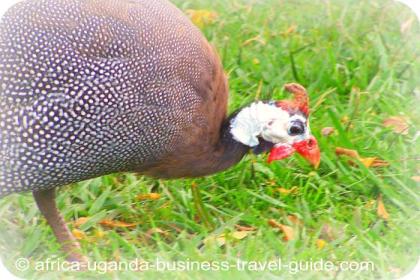
You will easily identify the adult birds by an upright bony casque on top of the head.
These Ugandan birds measure around 61-71cm.
You find the immature ones with smaller casque and wattles.
The young birds are not as entertaining as the adult ones, they are dull!
In this Uganda Birding Safari Guide we have described three races of helmeted guinea fowls in Uganda.
You can identify guinea fowls by their facial colors, shape & color of the casque and the shape of the throat wattle.
Among the helmeted fowls are
- The nominate,
- The somaliensis and
- The reichenowi.
The nominate birds have a variable- sized casque and rounded blue gape wattle.
The somaliensis have pointed blue wattles with red tips and a prominent tuft of bristles extending from the bill base.
And the reichenowi has a long casque and pointed red wattles.
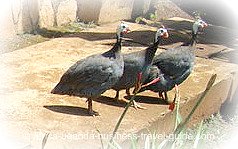
In your bird watching trip to Uganda you are most likely to come across the nominate ones.
They usually move in pairs and sometimes in small families.
Large flocks are usually widespread in grasslands.
What these Uganda birds feed on
The guinea fowls normally feed on seeds, small tubers and small insects.
Where to find them
Guinea fowls are common in a wide range of grassland, Bush country, and woodland.
You may easily identify them when you visit Entebbe botanical gardens.
Return to the index page of The Uganda Birding Safari Guide
Return to The Uganda Tourism Business Guide.